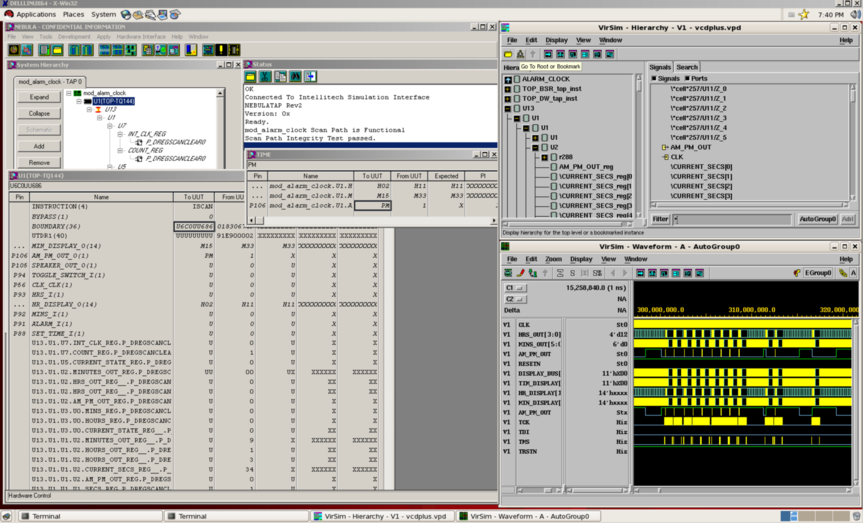
P1149.1-2012 JTAG/IJTAG Overview
The upcoming P1149.1-2012 standard includes new BSDL
support for what the standard calls "Clause 9" design specific
test data registers. Some engineers call these UDRs, or User Test Data Registers. Internal TDR registers, Internal JTAG, has
always been part of the standard however BSDL did not provide a
method to describe these registers until now. The new langauge
syntax in 1149.1-2012 BSDL, includes extensions that support
internal scan register field definitions and mnemonics (easy
to remember words associated with values in the register). This
data is compiled into a database where a GUI or scripting
langauge can access the on-chip internal registers. NEBULA
comes with ready support for these important features. |
attribute
REGISTER_FIELDS of Example :
entity is
"init_data (
"&
"((504 DOWNTO
500) IS Clock[5] IWRITE: Clockset(F100Mhz) ),"&
"((302 DOWNTO
300) IS Protocol[3] IWRITE: Protocol (off) ), "&
"((101 DOWNTO
100) IS Voltage[2] ), "&
"(( 19 DOWNTO
0) IS Reserved [20])"&
")" &
“intscan
( "&
"((163 DOWNTO
100) IS Address[64] ), "&
“((227
DOWNTO 164) IS Data[64] ), "&
“((228)
IS WE[1] ),
"&
);”
IEEE 1149.1-2012 Register Fields Attribute |
A new language for accessing the on-chip
registers called PDL, Procedure Definition Language enables IP
providers and IP integrators to create non-device specific
scripts for reading and writing to the registers. Future IEEE
P1687 also uses the PDL langauge but prefers to describe
registers and scan-chains through a new format called ICL -
Instrument Connectivity Language. ICL is closer to verilog in
its complexity but gives P1687 a few more features for
supporting legacy devices with unplanned DFT architectures. As ICL becomes more
solidified and customer need arises, this will be added to
NEBULA. The future P1687 in development also plans on using PDL
and a 'level 2' language based on PDL and TCL (without the TK
GUI in the standard).
These capabilities, now under
standardization, were first introduced in 1997 by Intellitech and
became the basis for Intellitech's NEBULA Silicon Debugger (NEBULA
Silicon Debugger) and other products. TCL or Tool Command
language is an open source language see www.tcl.tk. Intellitech pioneered using TCL with extensions for JTAG commands and named registers and mnemonics for in-situ on-chip access. In the 1990s, board test engineers selected visual basic and proprietary ICT langauges for JTAG, however TCL/TK is
used throughout the EDA industry for script development and
automation. Hence we have always seen it as a natural fit to access of on-chip IP or "Instruments". NEBULA fully supports PDL, TCL and TK.
The PDL and TCL language with extensions
enables scripts to be written that enable write and reads to
internal JTAG Test Data Registers and on-chip DFx structures
via the JTAG TAP. The major advantage of the approach is that
the scripts are re-targetable - there is no scan-chain bit and
shift information present like WGL or STIL ATE vector
languages. Unlike using Verilog for test benches, PDL/TCL give
the ability to validate JTAG/iJTAG based IP in simulation then
take the same PDL or TCL and execute against a real device. |
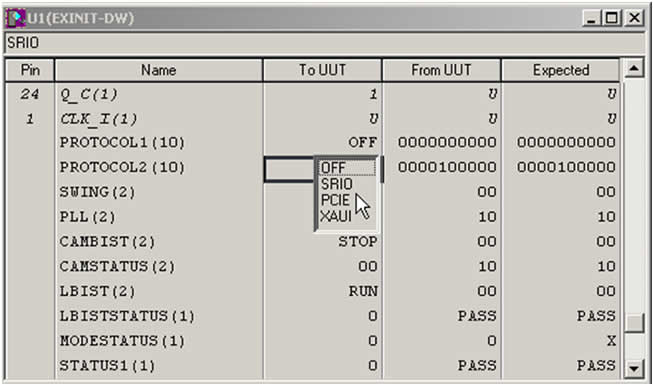
NEBULA GUI created from 1149.1-2012 BSDL
proc myprocedure {
# PDL/TCL script
iScope U1
iWrite LBIST RUN # bit-position independent register
iApply
iRunLoop 300000
iRead LBISTSTATUS PASS # check that LBIST passed
iApply
# set differential Swing to 400mv
iWrite SWING S400MV
iWrite PROTOCOL1 SRIO # set protocol to SRIO
iApply
# execute CAM BIST
iWrite CAMBIST RUN
iApply
iRead CAMSTATUS DONE
iApply
}
PDL/TCL script to operate on registers.
Comments are preceeded by "#"
Free software
Click the link in the sidebar to the left to learn more about the capabilities of the free NEBULA software. In order to download your free copy of the NEBULA client,
Xilinx USB Cableserver and ISIS, you must register on the
website here: Register.
|