Develop
- Simulate - Validate JTAG/IJTAG Silicon Instruments using
NEBULA
You can Register Here to download NEBULA 6.11. This is not a trial
software or an evaluation, it is free to use. We ask that you
provide valid information on who you are, a work email address and if you find it
useful, tell a friend or co-worker about NEBULA. Consultants
and 3rd parties are encouraged to get involved and use the
extensible PDL and TCL language to add new value added capabilities to
NEBULA or to develop JTAG controlled IP. If you are already a
verified registered user then you can proceed directly to the download page.
|
|
| |
Imagine - You, your vendors and your customers being able to use one common interface to control and observe on-chip IP, resources and instruments. The figure shows an example IC. The IEEE 1149.1-2013 standard supports an init-data register for configuring the analog paramaters of I/O as well as controlling on-chip PLLs. The standard further extends this by defining in BSDL user test data registers or 'scan chains'. These registers enable the ability of generic software to control and observe mission mode IP and instruments simply by describing the register interface in BSDL. |
|
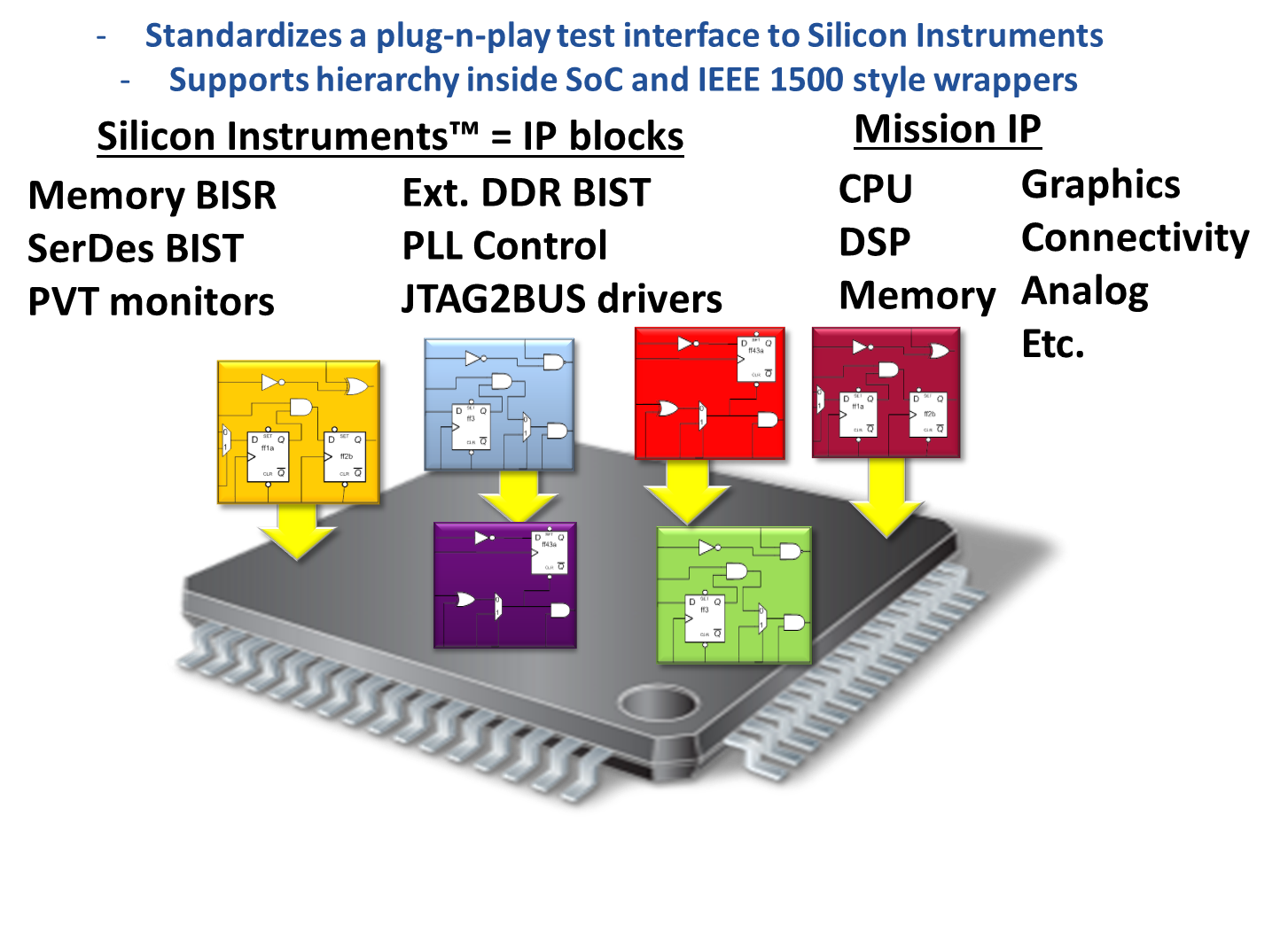
IC with on-chip IP managed by IEEE 1149.1-2013
|
Freely available software (with inexpensive FPGA JTAG Controllers) can then be used to communicate with the on-chip IP without the IC vendor needing to understand the entire system enviroment. On-chip analog and digital parameters can be set independent of the functional operation. This enables re-use during IC simulation, first silicon debug, during IC production test, first article shipment, failure analysis in-situ with customer's system. The re-use enables failure mode correlation across a number of disciplines and throughout the product life-cycle. A win for IC vendor and customers. |
|
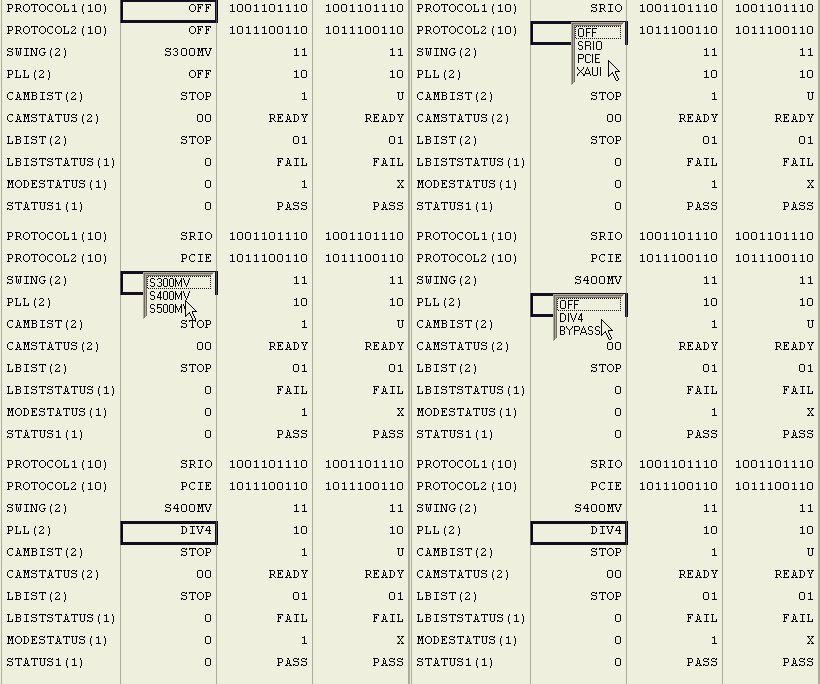
Spreadsheet View from BSDL
|
Both IEEE 1149.1-2013 and 1687 use a standard langauge called PDL, "Procedural Definition Language" to allow access via IJTAG to on-chip registers. The langauge is a high-level language without dependencies on locations of registers in long TDRs (Test Data Registers) or scan-chains. This is a standardization of a technique pioneered by Intellitech with JTAG register names and mnemonic extensions to TCL/TK.
iWrite PROTOCOL1 SRIO # set the protocol of SERDES to SRIO
iWrite PROTOCOL2 OFF
iWrite SWING S300MV # set the differial swing to 300mv
iRead CAMBISTSTATUS PASS # check that memory bist for the cam passed
iApply |
Scripts are independent of the top level IC architecture which enables IP providers (for FPGAs or SoCs) to provide pre-verified/pre-written PDL scripts for their IP. The PDL langauge is also integrated with the TCL/TK open langauge to enable branching, while loops, file I/O and complex operators such as math functions.
New to IEEE 1149.1-2013?
See this powerpoint from VTS2011 on IEEE P1149.1-2013: P1149.1-2013-VTS
See this powerpoint on new registers and mnemonics at ITC: IJTAG P1149.1-2013
|
|